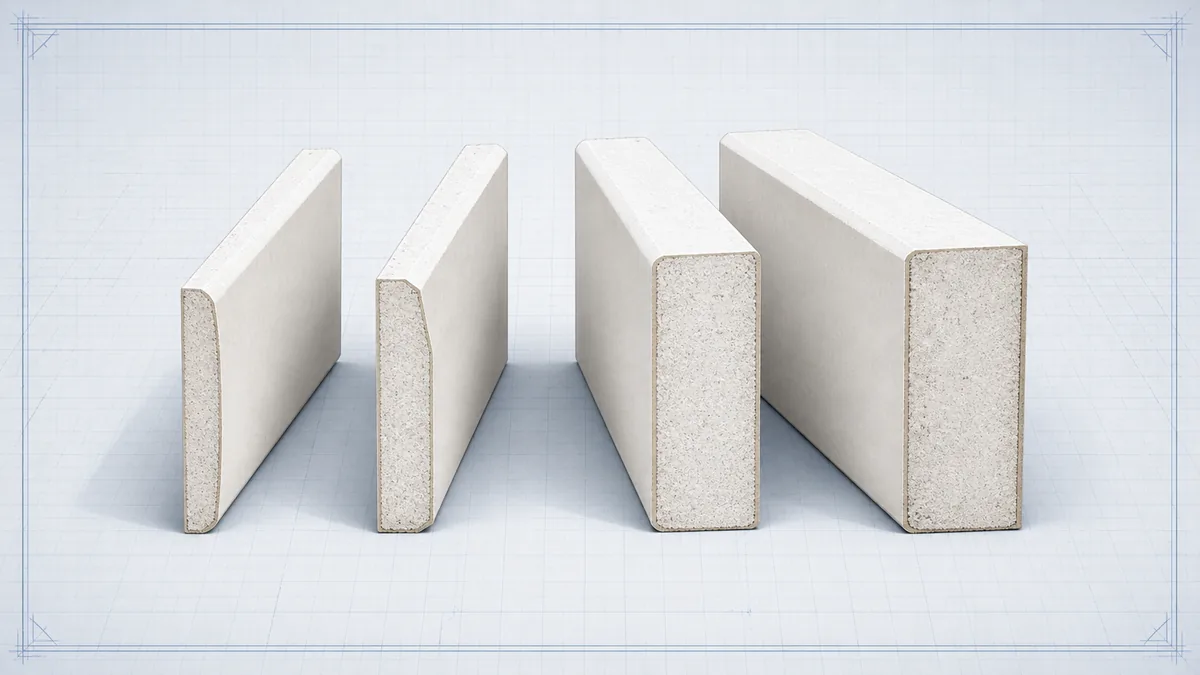
Walk the drywall aisle and you will find white, green, purple, blue and gray board, all roughly the same size and all priced very differently. The color is a manufacturer convention rather than a standard, but the categories behind them are real: moisture resistance, mold resistance, fire resistance, sound damping and impact resistance. This guide explains what each type is actually for, so you buy specialty board where it earns its price and standard board everywhere else.
Standard board, and why it is usually the right answer
Standard white-faced gypsum board covers the large majority of interior walls and ceilings. It is the cheapest per square foot, the easiest to cut and finish, and it is what every finishing product is designed around. Reach for something else only when there is a specific reason.
The specific reasons are: the surface will get wet or damp, the assembly needs a fire rating, you want to reduce sound transmission, or the wall will take physical abuse. Everything below maps onto one of those four.
Moisture and mold resistant board
- Moisture resistant (commonly green board): a wax-treated face and back for damp rooms. Suitable for bathroom walls away from direct spray, laundries and basements.
- Mold resistant (commonly purple): a treated core plus a fiberglass or coated facing that gives mold nothing organic to feed on. Better than green board in a genuinely humid room.
- Cement board or a tile backer: for anything inside a shower or tub surround that gets direct water. This is not drywall and should not be substituted with green board.
Moisture resistant does not mean waterproof. Green board behind tile in a shower is a well-known failure: the board eventually softens and the tile comes off. Direct-wet areas need a proper backer and a waterproofing membrane.
In a normal bathroom, a sensible split is a tile backer in the wet zone, mold resistant board on the rest of the bathroom walls, and standard board on the ceiling if the room has good extraction.
Fire, sound and impact board
- Type X: commonly 5/8 in with glass-fiber reinforcement, used as part of tested fire-rated assemblies. Garage requirements differ between walls and ceilings and depend on the adopted code.
- Type C: a further enhanced core used in specific rated ceiling and shaft assemblies where the listing calls for it.
- Sound damping board: a laminated panel with a viscoelastic layer that converts vibration into heat. One layer typically achieves what several layers of standard board would, which matters where wall thickness is limited.
- Abuse and impact resistant board: a denser core and a tougher facing for corridors, garages, workshops and rental turnovers.
Sound board is the one that most often gets bought unnecessarily. Sound travels through flanking paths, so a damping panel installed over a wall with rigid framing contact, no insulation and unsealed outlet boxes will disappoint. Fix the flanking paths first, add resilient channel or a staggered stud arrangement, and treat the specialty board as the last increment rather than the whole answer.
How specialty board changes your estimate
Sheet counts do not change: a 4x8 sheet is 32 sq ft in every type. What changes is price, weight and how the sheets cut.
- Moisture and mold resistant board: roughly 25% to 60% more per sheet than standard.
- Type X: usually 30% to 50% more, and heavier because it is 5/8 in.
- Sound damping board: several times the price of standard, and it needs a specific fastener pattern and often a special saw blade.
- Fiberglass-faced boards cut differently and can irritate skin. Long sleeves and a good mask, not just a dust mask.
The practical approach for a mixed job is to run the calculator once per board type: enter only the surfaces getting that board, using the surface toggles, and note each sheet count separately. Then price each line with its own price per sheet.
Square Feet Calculator
Get the area per surface so you can price each board type separately.
Frequently asked questions
Primary references
Manufacturer and industry guidance used to check this article.
- Sheetrock Brand Gypsum PanelsUSG
- Sheetrock Brand UltraLight Panels Mold ToughUSG
- 2024 IRC Section R302.6, dwelling and garage separationInternational Code Council
Product instructions, tested assemblies and local code take priority over general guidance.