Almost all drywall cutting is done with a knife, not a saw. Gypsum board is two sheets of paper with a brittle core between them, so the technique is to cut the paper and let the core snap along the line. Understanding that one fact turns cutting drywall from dusty, awkward work into something quiet and quick. This guide covers the four cuts you will actually make and how to keep the edges clean enough to finish.
The score and snap: straight cuts
- Stand the sheet face out and mark your measurement top and bottom.
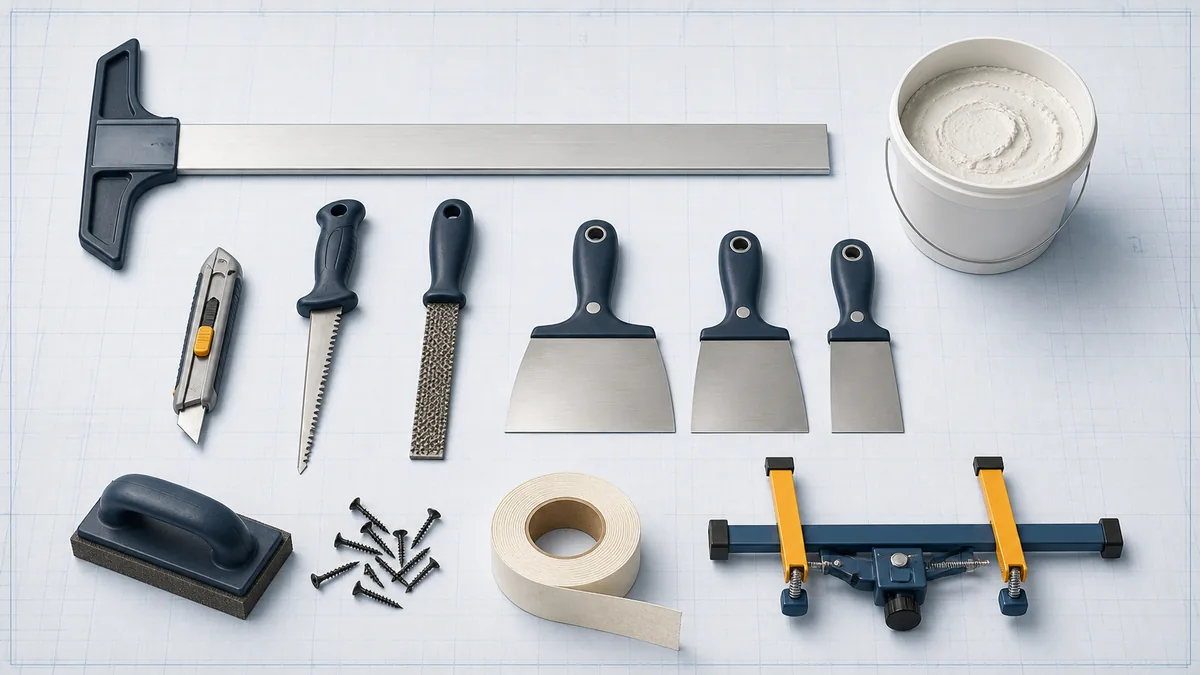
- Run a utility knife down the line against a drywall T-square or straightedge. Cut only the face paper, not into the core.
- Push the offcut back from behind. The core snaps cleanly along the score.
- Fold the offcut open and run the knife down the crease to cut the back paper.
- Dress the cut edge with a rasp or a couple of passes with the knife so it sits flat against its neighbor.
Two habits make the difference. Keep the blade sharp, changing it far more often than feels necessary, because a dull blade tears paper instead of cutting it. And always cut face up, so the visible side gets the clean scored edge and any ragged paper ends up on the back.
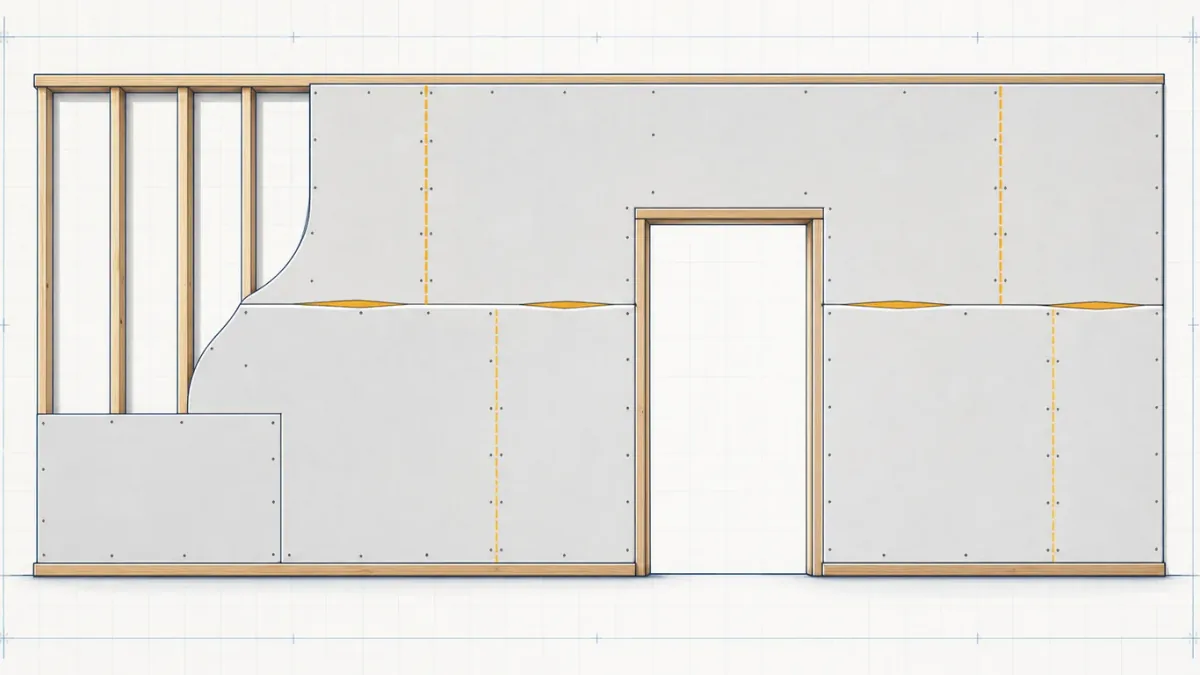
Cut sheets slightly small rather than slightly large. A 1/8 in gap disappears under tape and compound. A sheet that is 1/8 in too big has to come back down.
Outlets, switches and boxes
There are two approaches, and both are used by professionals for different situations.
- Measure and cut before hanging. Measure from a fixed reference such as the last sheet edge and the floor, transfer both dimensions to the board, and cut the opening with a jab saw. Accurate, and the only option where the box is deep in a corner.
- Rotary-cut in place. Tack the sheet up over the box, plunge a drywall router just inside the box, feel for the inside edge, then ride the bit around the outside of the box. Extremely fast once you have the knack, and the standard method on production work.
Whichever you use, aim for the box edge, not a margin around it. A cover plate hides only about 1/8 in of overcut. A hole cut generously wide means either a bigger plate or a filled and sanded patch behind it.
Kill the circuit before routing over a box. A carbide bit finds cable insulation very easily.
Curves, notches and awkward shapes
- Notches: cut the two short sides with a jab saw and score the long side, then snap. Faster than sawing all three.
- Circles for can lights: a hole saw in a drill, or score the circle with a knife in several passes and tap the middle out.
- Gentle curves: 1/4 in board bends readily. Dampening the face paper lightly with a sponge and letting it sit for a few minutes makes it more willing, then fasten progressively around the form.
- Tight curves: score the back paper in closely spaced parallel kerfs so the core can hinge, and support the board fully behind.
- Around pipes: drill an oversize hole rather than fighting a jab saw, and cover the gap with an escutcheon.
Dust, blades and offcuts
Scoring produces almost no dust, which is the main argument for using a knife over a saw. Where you do have to saw or rout, the dust is respirable gypsum and, in some products, silica.
- Wear a fitted P2 or N95 mask for any sawing, routing or sanding. A loose surgical mask does nothing here.
- Eye protection when routing overhead, always.
- Retract or snap off blades before setting a knife down. Drywall blades are changed often and end up everywhere.
- Keep offcuts sorted by size. Half of the pieces you cut can be used somewhere lower on a wall where trim will cover the joint, and that is where your waste factor gets earned back.
That last point connects directly to estimating. The standard 10% waste allowance assumes you reuse sensible offcuts. Throw every piece in the skip and 15% is closer to the truth, which is why the waste factor in our calculator is adjustable.
Drywall Calculator
Set your own waste factor once you know how much you will reuse.
Frequently asked questions
Primary references
Manufacturer and industry guidance used to check this article.
- Sheetrock Brand Installation and Finishing GuideUSG
- Application and Finishing of Gypsum Panel Products, GA-216-2010 archiveGypsum Association
Product instructions, tested assemblies and local code take priority over general guidance.